The Quiet Inflammation: How Gum Disease Spreads Its Damage Far Beyond Your Mouth
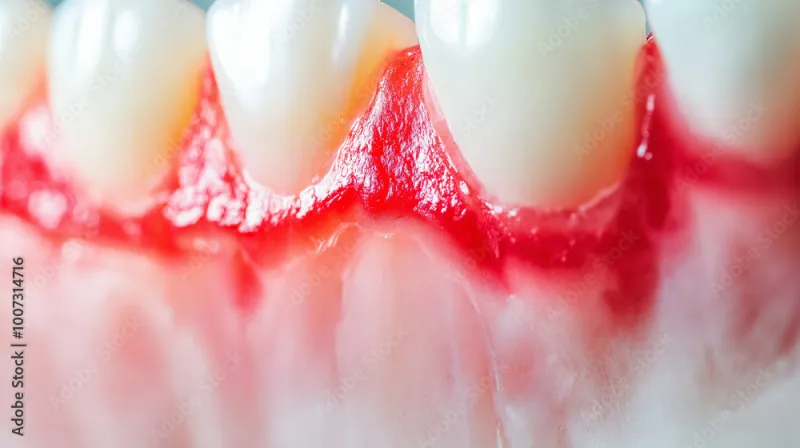
Photo: close up inflamed bleeding gums periodontal disease dental examination, via as2.ftcdn.net
Most people who have gum disease do not know it. That is not a dramatic overstatement — it is a clinical reality confirmed by the Centers for Disease Control and Prevention, which estimates that nearly half of American adults aged 30 and older have some form of periodontal disease. Among adults over 65, that figure rises to approximately 70 percent.
The disease earns its reputation for silence. In its early stages, it produces symptoms so minor and so easily rationalized that years can pass before a patient registers genuine concern. A small amount of blood in the sink after brushing. Gums that look slightly redder than usual. A faint tenderness that comes and goes. These are the whispers of a condition that, left unaddressed, does not confine its damage to the gum tissue it begins in.
What Periodontal Disease Actually Is
To understand why gum disease carries consequences throughout the body, it helps to understand what it is at a biological level. Periodontal disease is a chronic bacterial infection of the tissues that support the teeth — the gums, the periodontal ligament, and the underlying bone. It begins as gingivitis, a reversible inflammation of the gum tissue caused by bacterial plaque accumulating at the gumline. When gingivitis is not treated, it can progress to periodontitis, in which the infection migrates below the gumline, destroying the attachment between the tooth and its supporting structures.
As the infection deepens, the immune system mounts an inflammatory response. This is where the systemic story begins. The body's attempt to contain the bacterial assault produces inflammatory mediators — cytokines, prostaglandins, and other signaling molecules — that do not remain neatly localized. They enter the bloodstream. And once in circulation, they interact with tissues and organ systems far removed from the original infection site.
The Cardiovascular Connection
The link between periodontal disease and cardiovascular health is among the most extensively studied oral-systemic relationships in medicine. Multiple large-scale epidemiological studies have found that individuals with periodontal disease face a meaningfully elevated risk of heart disease, stroke, and arterial inflammation compared to those with healthy gum tissue.
The mechanisms proposed by researchers are several. One involves the direct entry of oral bacteria into the bloodstream through inflamed, ulcerated gum tissue — a phenomenon that occurs readily in patients with active periodontitis. Certain periodontal pathogens, including Porphyromonas gingivalis, have been identified in arterial plaques removed from patients with cardiovascular disease, suggesting a direct biological pathway.
A second mechanism involves the systemic inflammatory burden. The chronic low-grade inflammation characteristic of periodontal disease elevates C-reactive protein (CRP) and other inflammatory markers associated with cardiovascular risk. The heart and vasculature are not passive bystanders in this process — they are downstream recipients of an inflammatory signal that originated in the gums.
The American Heart Association has acknowledged the association between periodontal and cardiovascular disease while noting that causality has not been definitively established. What is clear is that the relationship is not coincidental, and cardiologists increasingly regard oral health as a relevant variable in their patients' overall risk profiles.
Diabetes: A Two-Way Street
The relationship between gum disease and diabetes is uniquely bidirectional, making it one of the most clinically significant oral-systemic connections in routine dental practice.
Diabetes impairs immune function and alters the inflammatory response, creating conditions in which periodontal bacteria proliferate more aggressively and gum tissue heals more slowly. Patients with poorly controlled diabetes are significantly more susceptible to severe periodontitis and experience faster disease progression than non-diabetic individuals.
But the influence runs in both directions. Active periodontal infection appears to worsen glycemic control in diabetic patients by sustaining a systemic inflammatory state that promotes insulin resistance. Multiple clinical trials have demonstrated that treating periodontal disease — through professional cleaning, scaling and root planing, and consistent maintenance — produces measurable improvements in HbA1c levels, the standard marker of long-term blood sugar control.
For the estimated 37 million Americans living with diabetes, this relationship is not a peripheral concern. It is a concrete reason why periodontal care is increasingly integrated into diabetes management protocols by forward-thinking healthcare providers.
Warning Signs That Deserve Immediate Attention
Because periodontal disease advances gradually and often without acute pain, patients frequently underestimate its severity. The following signs warrant a prompt dental evaluation — not a wait-and-see approach:
- Bleeding gums during brushing or flossing. Healthy gum tissue does not bleed with routine oral hygiene. Bleeding is inflammation, and inflammation is infection.
- Persistent bad breath that does not resolve with brushing. Bacterial byproducts in periodontal pockets produce sulfur compounds that cause chronic halitosis.
- Gum recession — the appearance that teeth are becoming longer — indicates that tissue is pulling away from the tooth, exposing root surfaces.
- Tooth sensitivity or looseness. As bone support diminishes, teeth may shift, separate, or develop sensitivity to temperature and pressure.
- Swollen, puffy, or darkened gum tissue. Changes in the color and texture of the gums are reliable early indicators of active disease.
Why Early Intervention Changes Everything
The distinction between gingivitis and periodontitis is not merely semantic — it is the difference between a reversible condition and a managed one. Gingivitis, caught early, can be eliminated entirely with professional cleaning and improved home care. Periodontitis, once established, cannot be cured; it can only be controlled. The goal of treatment shifts from elimination to arrest and maintenance.
Scaling and root planing — a deep-cleaning procedure performed below the gumline — is typically the first-line treatment for periodontitis. In more advanced cases, surgical intervention may be necessary to access and clean deep periodontal pockets. The cost, complexity, and recovery associated with treatment escalate as the disease progresses. Early detection is not merely preferable — it is economically and medically the most rational course.
At Pennwell Dental Group, periodontal health is evaluated at every comprehensive examination. Our clinical team understands that the gums are not a secondary concern — they are the foundation upon which every tooth rests and a window into the broader inflammatory state of the body. Routine dental visits are, in this sense, a form of systemic health monitoring.
The Appointment That Protects More Than Your Smile
The next time you notice blood on your toothbrush, resist the impulse to dismiss it. That small signal is your body communicating something worth listening to — not just about your gums, but about the complex, interconnected biological systems that gum disease has the capacity to disrupt. The inflammation that begins at the gumline does not stay there. And the decision to address it promptly is a decision that extends well beyond your oral health.