The Hidden Costs of Affordable Dentistry Abroad: What Patients Discover When They Return Home
A Decision That Begins With a Spreadsheet
The appeal of dental tourism is straightforward and, in many respects, entirely rational. A single dental implant in the United States can cost between $3,000 and $6,000. The same procedure in Mexico, Costa Rica, Hungary, or Thailand may be advertised for $800 to $1,500. For a patient facing multiple implants, a full-arch restoration, or extensive cosmetic work, the arithmetic appears compelling. A family could book flights, spend a week abroad, receive significant dental treatment, and return home having spent less than the cost of treatment at a domestic practice.
That calculation is not wrong, exactly. What it omits, however, is a set of variables that do not appear on any price comparison website — and that dentists across the United States are increasingly encountering as they treat patients who have returned from procedures performed abroad.
This is not an argument against international dental care categorically. It is an honest accounting of what can go wrong, how often it does, and what patients should understand before making this decision.
The Range of Outcomes Is Wider Than the Brochure Suggests
Dental tourism, as a category, encompasses an enormous range of clinical quality. There are internationally accredited dental facilities in countries such as Costa Rica, Mexico, and several European nations that maintain rigorous standards, employ highly trained clinicians, and use materials that meet or approach those used in the United States. Patients treated at these facilities often do fare well.
The problem is that the marketplace for dental tourism is largely unregulated from the consumer's perspective. A patient searching online for affordable dental implants abroad will encounter everything from world-class surgical centers to unlicensed clinics operating in converted storefronts — and the advertising for both can look nearly identical. Without a professional network, a referral from a trusted source, or the ability to independently verify credentials and facility standards, patients are navigating this landscape with limited information.
The American Dental Association and the U.S. Department of State have both issued guidance cautioning Americans about the risks of seeking medical and dental care abroad without thorough vetting. These warnings are not protectionist. They reflect the documented patterns of complications that American dentists are called upon to address.
What Comes Through the Door After the Trip
Dentists who practice in cities with significant dental tourism activity — border communities in Texas, Arizona, and California, as well as major metropolitan areas — have developed an informal familiarity with the types of complications that arrive in their chairs.
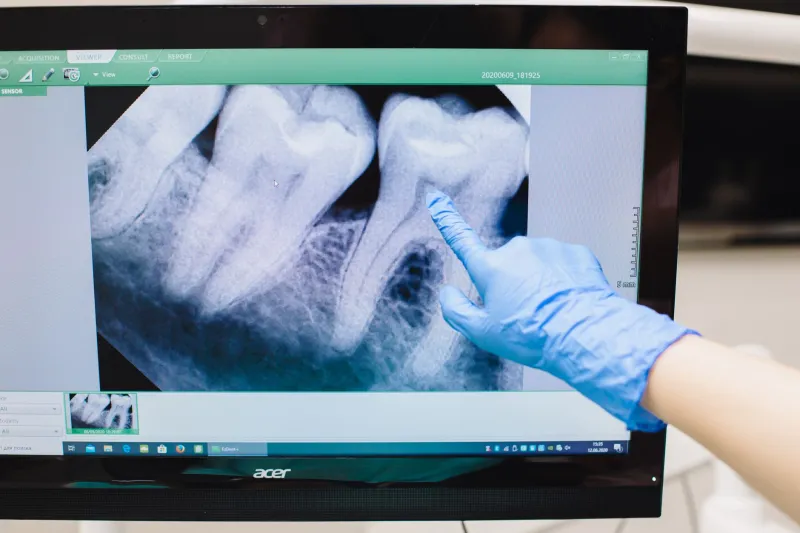
Implant failures represent a meaningful portion of these cases. Dental implants require precise surgical placement, adequate bone density, and a healing period during which osseointegration — the fusion of the implant to the surrounding bone — must occur successfully. When any of these variables is compromised, the implant fails. Patients who return home within days of implant placement, as the typical dental tourism itinerary requires, often do so before any indication of failure is detectable. Weeks or months later, when pain, swelling, or mobility develops, they are back in the United States seeking care from a dentist who had no involvement in the original procedure.
Repairing or replacing a failed implant is substantially more complex and expensive than placing one from scratch. Bone grafting may be required to address loss that occurred around the failed fixture. The total cost of remediation — including the original procedure abroad, travel expenses, and domestic corrective treatment — frequently exceeds what the patient would have paid for the procedure domestically from the outset.
Crowns and bridges fabricated abroad present a different but related set of challenges. Material standards, laboratory quality control, and the alloys used in metal-based restorations vary significantly by country and provider. American dentists have reported encountering restorations made from materials that are not commonly used or accepted domestically — in some cases, materials that raise concerns about biocompatibility or durability. When these restorations fail or require modification, the lack of documentation about what was used and how it was placed complicates every subsequent step.
The Continuity Problem
Beyond the technical complications lies a structural challenge that affects every patient who receives dental treatment abroad: continuity of care.
Dental treatment — particularly complex restorative work involving implants, crowns, and full-mouth reconstruction — is not a single transaction. It is an ongoing clinical relationship. The dentist who places an implant needs to monitor it. The clinician who fabricates a crown needs to know the patient's bite history, their opposing dentition, and their long-term oral health trajectory. Follow-up is not optional; it is integral to the success of the treatment.
When a patient returns home after receiving care abroad, that continuity is severed. The treating dentist is in another country, often in a different time zone, and has no ongoing relationship with the patient's domestic provider. If something goes wrong — an infection, a failed restoration, a bite that was not properly calibrated — the patient must start over with a domestic dentist who is working without the clinical records, the materials documentation, or the treatment context that would normally guide care.
Many domestic dentists are willing to help in these situations, but they are candid with patients about the limitations. Treating a complication from an unknown procedure, using unknown materials, performed by an unknown provider, is inherently more difficult and more uncertain than treating a straightforward case.
What to Consider Before Making This Decision
For patients who are genuinely weighing dental tourism as an option, there are questions worth asking before booking travel:
Can you verify the credentials of the treating clinician independently? Reputable international dental facilities will provide this information transparently. If it is difficult to obtain, that is meaningful information.
What happens if something goes wrong after you return? Ask the international practice explicitly how they handle post-treatment complications for international patients. A practice with a serious commitment to patient outcomes will have a clear answer.
Have you explored domestic financing options? Many American dental practices, including Pennwell Dental Group, offer payment plans and third-party financing arrangements that can make significant treatment financially accessible without the risks associated with international care. The gap between domestic and international costs is sometimes narrower than patients assume when financing is factored in.
Have you consulted with a domestic dentist first? A consultation with a qualified local dentist can clarify the scope of treatment needed, provide a realistic cost estimate, and sometimes identify less extensive options that were not apparent from an online self-assessment.
An Honest Perspective
The cost of dental care in the United States is a legitimate concern, and the financial pressure that drives patients to seek care abroad is real and understandable. Dismissing that reality would be neither honest nor helpful.
What we can offer, from the perspective of clinicians who see the full picture, is this: the price differential between domestic and international dental care is not always as large as it appears once complications, travel, and remediation are accounted for. And for complex, high-stakes procedures — implants, full-arch restorations, significant reconstructive work — the margin for error is narrow enough that the quality and continuity of care matter enormously.
We encourage patients who are facing significant dental treatment costs to have a frank conversation with their dental provider about all available options before making a decision they may need to live with for years.